
"More is different" - how states of matter emerge from quantum theory
Date:
Saturday, October 29, 2016 - 10:30
Overview:
The properties of all forms of matter, from the most mundane to the most exotic kinds produced in advanced laboratories, are consequences of the laws of quantum mechanics. Understanding how macroscopic behaviour emerges from microscopic laws in a system of many particles is one of the intellectually most demanding, yet most important, challenges of physics, and is the subject of this series of lectures.
Identical Particles: from One to Many
Video Podcast | Presentation (PDF)
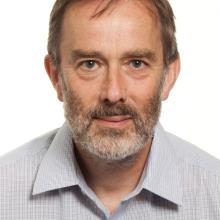
John Chalker will review the quantum mechanics of identical particles which forms the foundation for our understanding of why diamond is transparent and why gold conducts electricity. He will also explain how we can control the motion of electrons in certain devices to make resistances quantised with an accuracy of a few parts in a billion.
Magnets, superfluids and superconductors
Video Podcast | Presentation (PDF)
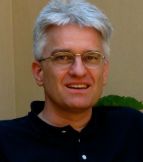
Fabian Essler will discuss the hugely successful framework for classifying possible states of quantum matter, pioneered by the great Russian Nobel Laureate, Lev Landau. This framework is conceptually remarkably simple, but is broad enough to describe physics ranging from magnets to superconductors to fundamental physics in the guise of relativistic quantum field theory and the Higgs phenomenon.
Topology and the Classification of Matter
Video Podcast | Presentation (PDF)
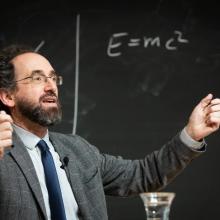
Steve Simon will focus on the recent realization that Landau's classification, thought to be complete for most of the twentieth century, in fact misses some of the most exciting, yet subtle, physics. The new missing ingredient is naturally cast in the language of the mathematical field of topology, giving rise to a host of what we now call topological states of matter. In particular, we have now realized that fundamentally new types of electronic materials exist --- some of which, in fact, have been hiding under our noses for decades!
Events Photos


